Refraction and Lenses Legacy Problem #8 Guided Solution
Problem*
The diagram below shows a ray of light traveling through air towards a thin layer of linseed oil (n = 1.50) resting on top of water (n=1.33). The light ray approaches the linseed oil at an angle of incidence of 48.2°.
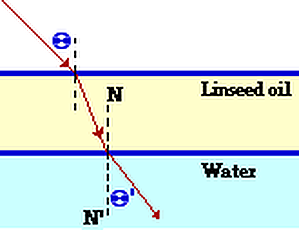
- Determine the angle of refraction at the air-linseed oil boundary.
- Determine the angle of refraction at the linseed oil-water boundary.
Audio Guided Solution
This type of problem is commonly called a layer problem. It's a layer problem in which there are two or more different layers laying up on top of one another with parallel boundaries. And light comes from air into one of the materials, refracts at its boundary, and then passes through that material, which is linseed oil, and comes to the next boundary with the water and refracts once more into the water. What we're asked to do is to calculate the two angles of refractions, the angle of refraction within the linseed oil and the angle of refraction within the water. We're given the n values of the oil. n oil equal 1.50, and the n value of the water, n water equal 1.33. And we can presume that the n value of the air is 1.00, and that's the original incident medium. We also know that the angle of incidence within the air is 48.2 degrees, and so we can use the three bits of information at the air linseed oil boundary in order to calculate the angle of refraction within the linseed oil. That's the top boundary where the angle theta is being shown on the diagram. And so applying Snell's Law there, I would say 1.00 times the sine of 48.2 degrees is equal to 1.50 times the sine of theta oil. And I can solve for theta oil. I need to first get the sine of theta oil by itself on the same side of the equation. It would be achieved by dividing each side of this equation by 1.50. I would have sine theta oil equal 0.46, sorry, 0.49698. Then I take the inverse sine, or on my calculator, the second sine of 0.49698, and I get 29.8007. I can round that to three significant digits, which is 29.8 degrees. Now I take a deep breath, and I'm ready to approach the second boundary. And in approaching the second boundary, I'm going to apply Snell's Law again. Now there's a trick to finding the angle of incidence at this second boundary. It's necessary to have that in order to calculate the angle of refraction. The angle of incidence at the second boundary is simply the angle of refraction at the first boundary. And the reason I know that is because on the diagram, I notice that there are two normal lines drawn to two different parallel boundaries. So those normal lines are parallel to one another. The angle of incidence at the first boundary is equal to the angle of refraction at the first boundary is equal to the angle of incidence at the second boundary, because they're alternating interior angles of parallel lines. And so, for that second boundary, I can say 1.50 times the sine of 29.8007 is equal to 1.33 times the sine of the angle in water. That's just Snell's Law applied to the second boundary. I can again divide each side of the equation by 1.33 in order to isolate the sine of theta water by itself on the same side of the equation. And it becomes sine of theta water equal 0.56051. Then I can take the inverse sine of 0.56051. That will give me the angle in water. It comes out to be 34.0910. And I can round that to the third significant digit, such that it's 34.1 degrees.
Solution
- 29.8°
- 34.1°
Habbits of an Effective Problem Solver
- Read the problem carefully and develop a mental picture of the physical situation. If necessary, sketch a simple diagram of the physical situation to help you visualize it.
- Identify the known and unknown quantities and record them in an organized manner. Equate given values to the symbols used to represent the corresponding quantity - e.g., \(\descriptive{d_o}{d_o,distance object} = 24.8\unit{cm}\); \(\descriptive{d_i}{d_i,distance image} = 16.7\unit{cm}\); \(\descriptive{f}{f,focal length} = \colorbox{gray}{Unknown}\).
- Use physics formulas and conceptual reasoning to plot a strategy for solving for the unknown quantity.
- Identify the appropriate formula(s) to use.
- Perform substitutions and algebraic manipulations in order to solve for the unknown quantity.
Read About It!
Get more information on the topic of Refraction and Lenses at The Physics Classroom Tutorial.