Refraction and Lenses Legacy Problem #18 Guided Solution
Problem*
In a physics lab, Anna Litical is studying the path of red laser light through an equiangular glass prism (n = 1.52). She observes that the light enters one face of the glass prism (boundary 1), refracts and then exits a second face of the glass prism (boundary 2) (shown below).
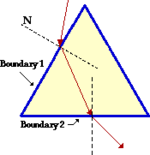
In her usual inquisitive manner, she ponders the question "I wonder if I could find an angle of approach to boundary 1 which would cause the light to undergo total internal reflection at boundary 2?" Calculate the angle of incidence at boundary 1 which would cause this total internal reflection at boundary 2.
Audio Guided Solution
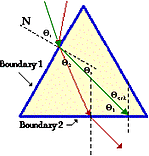
This is a very difficult problem, which involves a blending of good thinking, physics, and some geometric principles. The geometric principles pertain to angle relationships within triangles. Physics is Snell's Law, and the thinking involves thinking through how you're going to possibly get from the given information the unknown information. We'll start with the reading of the problem. Analytical study and experiment, she notices the path of the red light ray is shown in your diagram as it passes through an equal angular, read that to be a 60-60-60 degree triangle. The index of refraction of the material the triangle is made of is 1.52. She observes that the light enters the face 1, boundary 1, and exits boundary 2, but then she begins to think, what if I were to change the angle at boundary 1? Would it be possible to get light to undergo total internal refraction at boundary 2? What we wish to calculate is the angle of incidence at boundary 1 that gives you an angle that gives you a total internal reflection taking place at boundary 2. So in order to solve this problem, I'm going to have to work backwards, beginning with boundary 2, and then finding out what the angle of incidence is at boundary 1. This will involve several steps, but the one thing that I know that I can calculate is I can calculate the critical angle at boundary 2. Light is in the more dense prism, and trying to exit into the less dense air. We know the index of refraction of the prism is 1.52, and so we can find the critical angle there. I say 1.52 times the sine of the critical angle equals 1.00 times the sine of 90 degrees. And I solve for the critical angle. I get 41.1395. I write down the full answer, and I don't round it. I'm going to use that unrounded number in the rest of my calculations. Now you'll notice in my diagram, I've included the path in green for the light ray with which we're going to get light approaching the second boundary at the critical angle. And I've labeled several angles there. One of them is theta 1, and that's the angle between the approaching rate of that second boundary and the boundary itself. And I know the critical angle, which is the angle between this light ray and the normal. So what I know is that theta 1 and theta critical add up to 90 degrees, and I can calculate theta 1. It's the complement of theta critical. Comes out to be 48.8605. That's the angle 1 in my diagram. And I notice that there's a triangle that is formed by the green incident ray at that second boundary, and by the second boundary itself, and by boundary 1. It has as its corners the location where the refracted ray or incident ray at boundary 2 hits the boundary, and where the incident ray at boundary 1 hits the boundary, and then the lower left corner of this equal angular triangle. That little triangle has three angles, as all triangles do, and those three angles must add up to 180, as is the case for all triangles. And I know two of the angles. I just calculated theta 1 to be 48.8605, and I know that the lower left angle is 60 degrees, since this is an equal angular triangle. So I can find the angle that's labeled theta 2 in my diagram. That's the angle between boundary 1 and the refracted ray. That comes out to be 71.1395. I did that by saying theta 2 plus 60 plus theta 1 add up to 180 degrees, and I saw up to theta 2. So theta 2 is 71.1395 degrees, and it's the angle measured between the refracted ray at boundary 1 and the boundary itself. It's not the angular refraction, because we measure such angles with respect to the normal. But theta 2 plus theta r must add up to the 90 degrees. After all, the angles between the normal line and the boundary must add up to 90. So I can find theta r by simply subtracting theta 2 from 90 degrees. That comes out to be 18.8605. Now what I know at boundary 1 is I know two indices of refraction, and I know an angle of refraction. So I could use Snell's Law to calculate the angle of incidence. I say 1.00 times the sine of theta i is equal to 1.52 times the sine of 18.8605. And I solve for the angle of incidence, and it comes out to be 29.4 degrees.
Solution
29.4°
Habbits of an Effective Problem Solver
- Read the problem carefully and develop a mental picture of the physical situation. If necessary, sketch a simple diagram of the physical situation to help you visualize it.
- Identify the known and unknown quantities and record them in an organized manner. Equate given values to the symbols used to represent the corresponding quantity - e.g., \(\descriptive{d_o}{d_o,distance object} = 24.8\unit{cm}\); \(\descriptive{d_i}{d_i,distance image} = 16.7\unit{cm}\); \(\descriptive{f}{f,focal length} = \colorbox{gray}{Unknown}\).
- Use physics formulas and conceptual reasoning to plot a strategy for solving for the unknown quantity.
- Identify the appropriate formula(s) to use.
- Perform substitutions and algebraic manipulations in order to solve for the unknown quantity.
Read About It!
Get more information on the topic of Refraction and Lenses at The Physics Classroom Tutorial.