Refraction and Lenses Legacy Problem #12 Guided Solution
Problem*
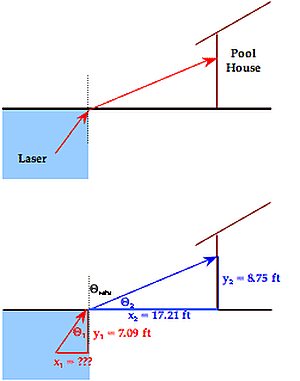
Ray Zuvlite is playing with his underwater laser. He descends beneath the water surface in his backyard pool to a vertical depth of 7.09 feet and directs the laser beam at an angle towards the pool's edge. The beam emerges from water (n=1.33) into air at the pool's very edge and projects onto a pool house which is located 17.21 feet horizontally from the pool's edge. The dot on the pool house is observed to be located at a vertical height of 8.75 feet. Determine the distance which Ray is located horizontally out from the edge of the pool.
Audio Guided Solution
This is a difficult problem, and like all difficult problems, it demands that you utilize the habits of an effective problem solver. You identify the known and unknown quantities, and you make an effort to visualize the situation. You plot out a strategy as to how to get from the known to the unknown values. I'm going to try to model that here, and it begins, for me, with the construction of a diagram that represents the physical situation. The physical situation involves Ray, who's underneath the water with his underwater laser. He shines the laser up towards the water's surface. It hits the water and exits from the water right at the edge of a pool. Then it travels through the air and hits a pool house. We're given the height above the surface of the water at which it hits the pool house, and that's at 8.75 feet. We're also given the distance from the very edge of the pool to the edge of the pool house, and that's 17.21 feet. Finally, we're given the depth to which Ray is underneath the water. That's a vertical distance, 7.09 feet from the water's surface down. Of course, we know the index of refraction of water is 1.33, and that of air is 1.00. What we wish to calculate is the distance from the edge of the pool horizontally out to the location of Ray with his laser. We wish to find x1 in the second provided diagram that I have here. Now, these two diagrams, the top one being just a sketch of the physical situation, and the second one, the bottom one, being a representation of the known and unknown quantities in terms of variables, which I've just defined arbitrarily as x2 and y2 and y1 and x1. You'll notice that color-coded two triangles, one triangle being triangle 1, the red triangle, represents the information from water's surface underneath the water where Ray is located, the other one being the blue triangle I'll call triangle 2, and that represents information above the water's surface over towards the pool house. Now, I know x2 and y2. I'm looking for x1. Now, as I plot out the strategy here, I'm thinking, well, in order to find x1, it might be helpful to know theta 1, and then I could use some tangent to find x1. So how do I get theta 1? Well, the only way to get theta 1 is to maybe employ Snell's Law and to know theta refraction, the angle of refraction there. Now, how do I get angle of refraction? Well, geometrically, that would be the complement of theta 2. So if I can find theta 2, I can find theta refraction, theta 1, and finally x1. How do I get theta 2? Well, that's a little trigonometry with that blue triangle there, and that's going to be where I start. I'm going to find theta 2 by applying the tangent function to that blue triangle. It would begin by saying the tangent of theta 2 equal the side opposite y2 over the side adjacent x2. I can plug in 8.75 and 17.21 at y2 and x2, and that would be a ratio of 0.50843. Theta 2 is the inverse tangent of 0.50843. That gives me 26.9499 is the angle of theta 2. Now, theta 2 is the complementary angle of the angle of refraction. So if I subtract it from 90 degrees, that gives me the value of the angle of refraction of light as it exits into the air. That comes out to be 63.0501. That's the angle of refraction. Now, for my third step, I'm going to find theta 1 by applying Snell's Law to the water-air boundary. That would be 1.33 times the sine of theta 1 is equal to 1.00 times the angle of refraction. 63.0501 is the angle of refraction. So I can divide each side of this equation by 1.33, and it comes to the sine of theta 1 equal 0.67023. Take the inverse sine of this, second sine of 0.67023, gives me 42.0846 is theta 1. Now I'm almost home. I need to find x1, which is the horizontal side of that red triangle 1. So I could say tangent of theta 1 equal the side opposite over the side adjacent. That's the tangent of theta 1 equal x1 divided by y1. Theta 1 is known as 42.0846, and y1 was given to me as 7.09 feet. So substituting in and rearranging, I have x1 equal 7.09 times the tangent of 42.0846. That comes out to be 6.4029 feet, and I can round that to three significant digits.
Solution
6.40 ft
Habbits of an Effective Problem Solver
- Read the problem carefully and develop a mental picture of the physical situation. If necessary, sketch a simple diagram of the physical situation to help you visualize it.
- Identify the known and unknown quantities and record them in an organized manner. Equate given values to the symbols used to represent the corresponding quantity - e.g., \(\descriptive{d_o}{d_o,distance object} = 24.8\unit{cm}\); \(\descriptive{d_i}{d_i,distance image} = 16.7\unit{cm}\); \(\descriptive{f}{f,focal length} = \colorbox{gray}{Unknown}\).
- Use physics formulas and conceptual reasoning to plot a strategy for solving for the unknown quantity.
- Identify the appropriate formula(s) to use.
- Perform substitutions and algebraic manipulations in order to solve for the unknown quantity.
Read About It!
Get more information on the topic of Refraction and Lenses at The Physics Classroom Tutorial.