Refraction and Lenses Legacy Problem #9 Guided Solution
Problem*
A light ray is traveling through crown glass (n = 1.52) and approaching the boundary with water (n = 1.33) as shown in the diagram below.
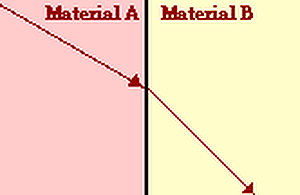
- Use a protractor to measure the angle of incidence of the light ray in the crown glass.
- Calculate the angle of refraction of the light ray as it enters into the water.
Audio Guided Solution
In this question, the diagram is shown with an incident ray traveling through crown glass and approaching the boundary with water. The index of refraction of crown glass is given, 1.52, and the index of refraction of water is also given, 1.33. The problem starts by asking me to use a protractor to measure the angle of incidence of the light ray in the crown glass. So that's part A, and then part B, once I've found that part A answer, use it to calculate the angle of refraction of the light ray as it enters into the water. That's a Snell's Law calculation. So for part A, I need to get a transparent protractor and lay it down so that I can measure the angle between the incident ray and a normal line drawn to the boundary. Now a normal line is simply a line that's perpendicular to the boundary at the point of incidence of the light ray. Measuring that angle between the perpendicular and the red light ray gives me an angle of about 49 degrees, maybe 50, 51, 48, something in there. Once I get my value for the angle of incidence within the crown glass, I can now answer part B using Snell's Law. I'm going to set up the Snell's Law equation as 1.52 times the sine of 49 degrees, or whatever angle you measure, is equal to 1.33 times the sine of the angle in water. And now I have to solve for the sine of the angle in water. I do that by dividing both sides of the equation by 1.33 and then evaluating the left side of the equation with all the numbers. That comes out to be 0.86253 is equal to the sine of the angle in water. To find the angle in water, I need to employ this inverse sine function. I go second sine of 0.86253. Calculator tells me the answer is 59.013 degrees. That's the angle in the water. And I can round that to either two or three significant digits, depending on how precise you consider your angle measure to be. If I consider it to be accurate to the second digit, then I'm going to round this final answer in Part B to the second digit, and it would become 60 point degrees. Now I have to mention that if you didn't measure 49 degrees as I did, for the angle between the crown glass and the normal line, then you're probably not going to get the same 59.6013 degrees answer for Part B. And you just need to employ the same strategy of going 1.52 times the sine of whatever angle you measure, divided by 1.33. Evaluate that sine, and then take the inverse sine of it, and you've got your answer. Good luck.
Solution
- 49°
- 60.°
Habbits of an Effective Problem Solver
- Read the problem carefully and develop a mental picture of the physical situation. If necessary, sketch a simple diagram of the physical situation to help you visualize it.
- Identify the known and unknown quantities and record them in an organized manner. Equate given values to the symbols used to represent the corresponding quantity - e.g., \(\descriptive{d_o}{d_o,distance object} = 24.8\unit{cm}\); \(\descriptive{d_i}{d_i,distance image} = 16.7\unit{cm}\); \(\descriptive{f}{f,focal length} = \colorbox{gray}{Unknown}\).
- Use physics formulas and conceptual reasoning to plot a strategy for solving for the unknown quantity.
- Identify the appropriate formula(s) to use.
- Perform substitutions and algebraic manipulations in order to solve for the unknown quantity.
Read About It!
Get more information on the topic of Refraction and Lenses at The Physics Classroom Tutorial.