Refraction and Lenses Legacy Problem #7 Guided Solution
Problem*
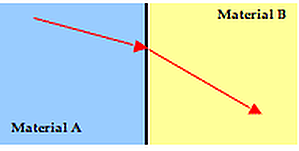
The diagram at the right shows light refracting from material A into material B. The index of refraction of material A is 2.24. Use your protractor to measure angles and determine the index of refraction of material B. (HINT: The angle measures are multiples of 15 degrees.)
Audio Guided Solution
In this problem, I'm given a diagram in which it shows a ray of light passing from material A into material B, bending away from the normal line as it does. And I'm given that the index of refraction of material A is 2.24. That's the end value of material A. It says use your protractor to measure the angles and determine the index of refraction of material B. I wish to find the end value of B. I can use a protractor and just line it up on the diagram in order to measure the angle that the light ray makes with the normal line within material A and within material B. When I do that, I find it makes a 15 degree angle of incidence within material A. That's the angle between the incident ray and the imaginary normal line drawn to the surface. And in B, the angle ends up being 30 degrees. I'm using 15 degrees and 30 degrees even though I might have measured 16 and 32. I'm using 15 and 30 because it tells me that the angle measures are intended to be multiples of 15 degrees. Now I know three quantities about this refraction problem. I know the n1 value, n of material A, and the theta1 value, the angle of incidence within material A. And I know the theta2 value, the index of the angle of refraction within material B. And I want to find the fourth quantity, n2, or the index of refraction of material B. So to do that, I just substitute into the Snell's Law equation n1 sine theta1 equals n2 sine theta2. And it becomes 2.24 times the sine of 15 degrees is equal to nr, the unknown quantity, or n2, the unknown quantity, times the sine of 30 degrees. I can divide each side of the equation by the sine of 30 degrees to get n2 by itself. And then I can solve for n2, and I get 1.1595. And I can round that to the third significant digit.
Solution
Angle of incidence: 15°
Angle of refraction: 30°
Index of Refraction: 1.16
Habbits of an Effective Problem Solver
- Read the problem carefully and develop a mental picture of the physical situation. If necessary, sketch a simple diagram of the physical situation to help you visualize it.
- Identify the known and unknown quantities and record them in an organized manner. Equate given values to the symbols used to represent the corresponding quantity - e.g., \(\descriptive{d_o}{d_o,distance object} = 24.8\unit{cm}\); \(\descriptive{d_i}{d_i,distance image} = 16.7\unit{cm}\); \(\descriptive{f}{f,focal length} = \colorbox{gray}{Unknown}\).
- Use physics formulas and conceptual reasoning to plot a strategy for solving for the unknown quantity.
- Identify the appropriate formula(s) to use.
- Perform substitutions and algebraic manipulations in order to solve for the unknown quantity.
Read About It!
Get more information on the topic of Refraction and Lenses at The Physics Classroom Tutorial.