Refraction and Lenses Legacy Problem #22 Guided Solution
Problem*
During the Finding Smiley Lab, Tyrone and Mia place a small light bulb at various distances from a converging lens. The light bulb has a smiley face marked on one of its side. Their goal is to locate the images of the light bulb by projecting the refracted light onto a note card.
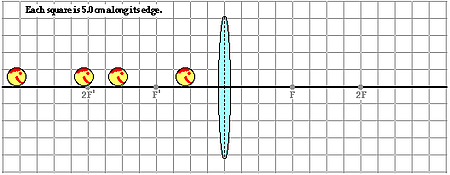
The lens is known to have a focal length of 20. cm. Predict the image distances which Tyrone and Mia will likely determine when the smiley face is located a distance of …
-
- cm from the lens.
-
- cm from the lens.
-
- cm from the lens.
-
- cm from the lens.
Audio Guided Solution
This question centers around an activity performed by two students in which they place a lightbulb at varying distances from a converging lens. In the question, we wish to calculate the distance from the image of the lightbulb to the lens itself. In other words, we wish to find the image distance. In order to find the image distance, the object distance and the focal length must be known. In the question, they state that the focal length is 20 centimeters. If we only knew the object distances, we could calculate the corresponding image distances. In part A of the problem, they give an object distance of 60 centimeters. Using this object distance, we can calculate the image distance using the lens equation. We would say 1 over 20 is equal to 1 over 60 plus 1 over d image. We'd rearrange the equation to get the d image term by itself. So 1 over d image is equal to 1 over 20 minus 1 over 60. At this point, you can plug the numbers into your calculator and evaluate the answer. Or, you could find a loss common denominator and then add the two fractions up. If you were to do it the second way, the 1 over 20 would be the same as 3 over 60. Then you go minus 1 over 60. 3 over 60 minus 1 over 60 is a common denominator of 60. So you can group the numerators together over the same common denominator, such that it would be 3 minus 1 over 60 or 2 over 60. This is the same as 30 centimeters. That's the image distance for part A. You can repeat the process for the other values of object distances. Using the same equation, rearrange to 1 over d image equal 1 over 20 minus 1 over object distance. If you prefer, you can just as easily use your calculator to evaluate the left side. In B, if I were to do it on my calculator, I would be doing 1 divided by 20 minus 1 divided by 40. Then I would evaluate that. Once I do, I would be finding 1 over object, 1 over image distance. Then I would take the reciprocal of the answer, of the number, in order to get the answer. And I would get 40 centimeters in part B. The process continues for the other parts of this problem.
Solution
-
- cm from the lens (to the right)
-
- cm from the lens (to the right)
-
- cm from the lens (to the right)
-
- cm from the lens (to the left, corresponding to an dimage of -20. cm)
Habbits of an Effective Problem Solver
- Read the problem carefully and develop a mental picture of the physical situation. If necessary, sketch a simple diagram of the physical situation to help you visualize it.
- Identify the known and unknown quantities and record them in an organized manner. Equate given values to the symbols used to represent the corresponding quantity - e.g., \(\descriptive{d_o}{d_o,distance object} = 24.8\unit{cm}\); \(\descriptive{d_i}{d_i,distance image} = 16.7\unit{cm}\); \(\descriptive{f}{f,focal length} = \colorbox{gray}{Unknown}\).
- Use physics formulas and conceptual reasoning to plot a strategy for solving for the unknown quantity.
- Identify the appropriate formula(s) to use.
- Perform substitutions and algebraic manipulations in order to solve for the unknown quantity.
Read About It!
Get more information on the topic of Refraction and Lenses at The Physics Classroom Tutorial.