Refraction and Lenses Legacy Problem #2 Guided Solution
Problem*
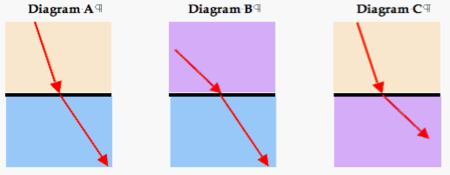
Consider the three diagrams below. Measure the angle of incidence and of refraction (in degrees) for each of the three diagrams.
Audio Guided Solution
In question two you have to determine the angle of incidence and the angle of refraction for three different diagrams And there's only one way to do that. You have to measure it. You have to get on a protractor that has angle measurement capability You need to place it down and so you know what is meant by angle of incidence and angle of refraction The angle of incidence is simply the angle that is made By the intersection of the normal line to a surface in the incident ray and for the angle of refraction It's the angle between the same normal line and the refracted ray Now a normal line is just a line that is drawn perpendicular to the surface where the incident ray Meets the surface in each case. There's no normal line drawn You can either draw it yourself or imagine it if you're drawing it yourself You might want to make sure that you print the paper out before you actually draw Generally speaking drawn on a computer screen is not a wise idea Now in this question in order to measure that angle I simply put my protractor on the page and I line it up either with the imaginary or drawn normal line or With the surface and then I measure the angle from the normal line to the incident ray in the case of part a that angles 20 degrees in the case of Part a or diagram a the angle of refraction It's 35 degrees Now these are my measurements my best estimate if you got 18 or 22 degrees for the angle of incidence I want to have a count about that That's just a little difference in measurement and that's going to happen whenever we're measuring something in Part B or diagram B you do much the same thing Only there you're going to get a bigger angle for the angle of incidence Comes out to be around 45 degrees plus or minus 2 degrees The angle of refraction seems to be right around 33 degrees or thereabouts again plus or minus 2 degrees Now if you're not getting these angle measurements check the alignment of your protractor Because as you do check the alignment what you want to make sure is that you're certainly measuring degrees From the normal line to this incident ray Now depending on what your protractor is and how it reads you could just be reading a number off of the protractor But you may need to do more than that The number that you read depends upon how it's how it is how your protractor is aligned And how your protractor prints those numbers some of them print them from the left side going around To the right side from 0 to 180 others start in the middle and go Start at the normal line and go 0 to 90 both ways so check your protractor out I actually simply count 10 degree increments And then I find the remaining amount that's left over after my 10 degree increments And I do that counting starting at the normal line Good luck
Solution
Diagram A: angle of incidence = 20°; angle of refraction = 35°
Diagram B: angle of incidence = 45°; angle of refraction = 33°
Diagram C: angle of incidence = 10°; angle of refraction = 48°
Habbits of an Effective Problem Solver
- Read the problem carefully and develop a mental picture of the physical situation. If necessary, sketch a simple diagram of the physical situation to help you visualize it.
- Identify the known and unknown quantities and record them in an organized manner. Equate given values to the symbols used to represent the corresponding quantity - e.g., \(\descriptive{d_o}{d_o,distance object} = 24.8\unit{cm}\); \(\descriptive{d_i}{d_i,distance image} = 16.7\unit{cm}\); \(\descriptive{f}{f,focal length} = \colorbox{gray}{Unknown}\).
- Use physics formulas and conceptual reasoning to plot a strategy for solving for the unknown quantity.
- Identify the appropriate formula(s) to use.
- Perform substitutions and algebraic manipulations in order to solve for the unknown quantity.
Read About It!
Get more information on the topic of Refraction and Lenses at The Physics Classroom Tutorial.