1D Kinematics Legacy Problem #10 Guided Solution
Problem*
The position-time graph below represents the motion of South's basketball coach during the last sixteen seconds of overtime during this past weekend's game.
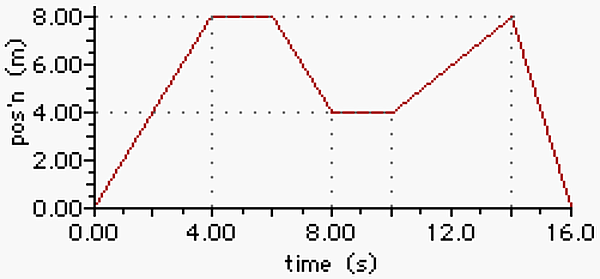
Use the graph to answer the next several questions.
- Determine the total distance walked by the coach during these 16 seconds.
- Determine the resulting displacement of the coach during these 16 seconds.
- Determine the displacement of the coach after 12.0 seconds.
- At what time did the coach have the greatest displacement from his starting position?
- What was the fastest speed which the coach walked during any of the time intervals for the last 16.0 seconds?
- What was the average speed of the coach for these 16.0 seconds?
Audio Guided Solution
There are many ways to describe the motion of an object. We could use words to describe it, diagrams, equations, graphs, numbers, etc. And here in this problem we have the motion of a basketball coach during the last 16 seconds of the overtime being described by a position time graph. In other words, over the course of those 16 seconds, we're representing the motion, at least the position aspect of the coach's motion, in the form of a graph. And the answers to these questions are dependent upon understanding the nature of this graph, because the graph describes the motion. So I'm going to kind of talk this through, and I want you to follow along in the graph. I'm not going to give much in the way of answers to the questions, but I'm going to describe the graph, because if you get the graph, you get the answers. So here what we have going on is for the first four seconds, our coach starts at the reference point of zero meters, and begins to walk. And in the first four seconds, walks eight meters at a constant speed, such that after four seconds, he's eight meters from the starting point. Now from four to six seconds, you notice the plateau in the graph, indicating a constant position being held by the coach. So he walks, or she walks, for eight meters and four seconds, and then maintains that position for two seconds. Then we start to notice the position values begin to decrease from eight meters to four meters over the course of the next two seconds, from six to eight. The coach has just turned around and walked back the other way. You've got a picture now of a coach that's starting to get a little nervous, as you would think, over time, the last 16 seconds. Now from eight seconds to 10 seconds, the coach is stationary again, as denoted by the plateau, still four meters from the starting position. And then finally at 10 seconds, begins to move again and change his position, such that over the course of the next four seconds, from 10 to 14 seconds, he walks again from four meters to eight meters, again eight meters away from the starting position. That's a displacement of four meters during that four second period. Finally immediately turns around, no plateau at 14 seconds, turns around, walks back to the starting point, finishes where he started. So we have a picture of a coach pacing back and forth, and we're asked a number of questions. Some of them have to do with distance. That is, add up all the position changes for all the moving segments during that graph. That's eight and four, and four and eight is what we get. We end up getting a total distance walked of 24 meters. And then in B, you have to find the displacement. And in C, it's the same thing. You need to find some displacement values. So the way you'd find displacement is start to finish, zero seconds to finishing point. And so if they're asked what's the resulting displacement for all 16 seconds, that's kind of a straightforward one. It's just simply zero meters. Finish where we started, kind of a round-trip motion, as in all round-trip motion, there's no displacement. Then you have to get the displacement after 12 seconds, so this demands a little careful reading of the graph. At 12 seconds, the coach is at six meters. You'll have to kind of trace a horizontal across, actually a vertical up from 12 seconds to the line, and a horizontal across the axis. You should find that six meters. So what we have there at 12 seconds is the coach is six meters away from the starting point of zero. And then another question that they ask is, what's the displacement? What time did the coach have the greatest displacement? Well, whenever he's at eight meters, and so there's two periods in which he's at eight meters. And then what was the fastest speed which the coach walked during any of these time intervals? Well, you're looking for the steepest slope, and that takes place in the last two seconds, which the coach walked back towards starting position, walking eight meters in two seconds, so that's four meters per second. Finally, the average speed for all 16 seconds is a matter of taking the total distance walked at 24 meters and dividing by the time of 16 seconds.
Solution
- 24 m
- 0 m
- 6 m
- 4-6 seconds and again at 14 seconds
- 4 m/s
- 1.5 m/s
Habbits of an Effective Problem Solver
- Read the problem carefully and develop a mental picture of the physical situation. If necessary, sketch a simple diagram of the physical situation to help you visualize it.
- Identify the known and unknown quantities in an organized manner. Equate given values to the symbols used to represent the corresponding quantity - e.g., \(v_o = \units{0}{\unitfrac{m}{s}}\); \(a = \units{4.2}{\unitfrac{m}{s^2}}\); \(v_f = \units{22.9}{\unitfrac{m}{s}}\); \(d = \colorbox{gray}{Unknown}\).
- Use physics formulas and conceptual reasoning to plot a strategy for solving for the unknown quantity.
- Identify the appropriate formula(s) to use.
- Perform substitutions and algebraic manipulations in order to solve for the unknown quantity.
Read About It!
Get more information on the topic of 1D Kinematics at The Physics Classroom Tutorial.