1D Kinematics Legacy Problem #13 Guided Solution
Problem*
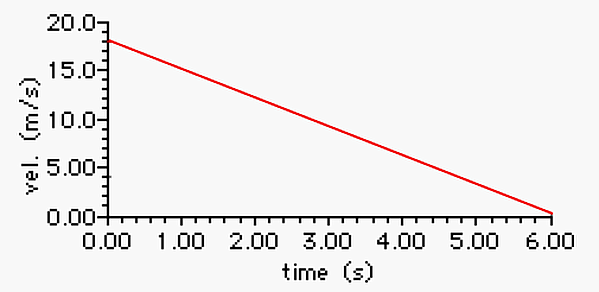
Renatta Gas did it again. She failed to fill up her tank during the last four weeks. The velocity-time graph below represents the last six seconds of motion her car before being stranded on a highway in route to her university.
Use this graph to determine …
- … the acceleration of Renatta's car.
- … the distance traveled during her last 6.0 seconds of motion.
Audio Guided Solution
There are many ways to describe the motion of objects, from words to diagrams to numbers to equations and finally to graphs, and here what we're doing is describing the motion of Renata Gas using a velocity time-graph. So we're representing over the course of six seconds changes in the velocity of Renata's car, who unfortunately has once more forgotten to fill up her tank. So what I observe is I observe the line sloping downwards indicate the velocity is decreasing, from an initial value of 18 meters per second to a value of zero meters per second at six seconds, and I'm asked two questions. I'm asked to determine the acceleration, and I'm asked to determine the distance. The two things you need to know about velocity time-graphs is that the slope is representative of an object's acceleration, and the area under the line, that is between the line on the graph, and the time axis is representative of the distance traveled by the object. So in this case, in answering A, I'm going to have to calculate a slope, a rise-per-run ratio. That demands that you get two coordinates, for instance, zero seconds and 18 meters per second, and six seconds, zero meters per second, and you do a rise-per-run calculation or a delta y over delta x calculation. So this line rises negative 18 meters per second, meaning it actually falls 18 meters per second, and it runs across six seconds. So I just do that ratio, and I get negative 3.0 meters per second per second. And then to get the area or the displacement or distance of Renata during these six seconds, I have to find the area of a triangle, a triangle being bound on the left side by the velocity axis, on the underside by the time axis, and along the diagonal by the red line. And so that's a one-half base-height calculation for a triangle. I need to go one-half times the base of six seconds times the height of 18 meters per second. So one-half 18 times six will give me a distance.
Solution
- -3.0 m/s/s
- 54 m
Habbits of an Effective Problem Solver
- Read the problem carefully and develop a mental picture of the physical situation. If necessary, sketch a simple diagram of the physical situation to help you visualize it.
- Identify the known and unknown quantities in an organized manner. Equate given values to the symbols used to represent the corresponding quantity - e.g., \(v_o = \units{0}{\unitfrac{m}{s}}\); \(a = \units{4.2}{\unitfrac{m}{s^2}}\); \(v_f = \units{22.9}{\unitfrac{m}{s}}\); \(d = \colorbox{gray}{Unknown}\).
- Use physics formulas and conceptual reasoning to plot a strategy for solving for the unknown quantity.
- Identify the appropriate formula(s) to use.
- Perform substitutions and algebraic manipulations in order to solve for the unknown quantity.
Read About It!
Get more information on the topic of 1D Kinematics at The Physics Classroom Tutorial.