1D Kinematics Legacy Problem #32 Guided Solution
Problem*
Alexander's hobby is dirt biking. On one occasion last weekend, he accelerated from rest to 17.8 m/s/s in 1.56 seconds. He then maintained this speed for 9.47 seconds. Seeing a coyote cross the trail ahead of him, he abruptly stops in 2.79 seconds. Determine Alexander's average speed for this motion.
Audio Guided Solution
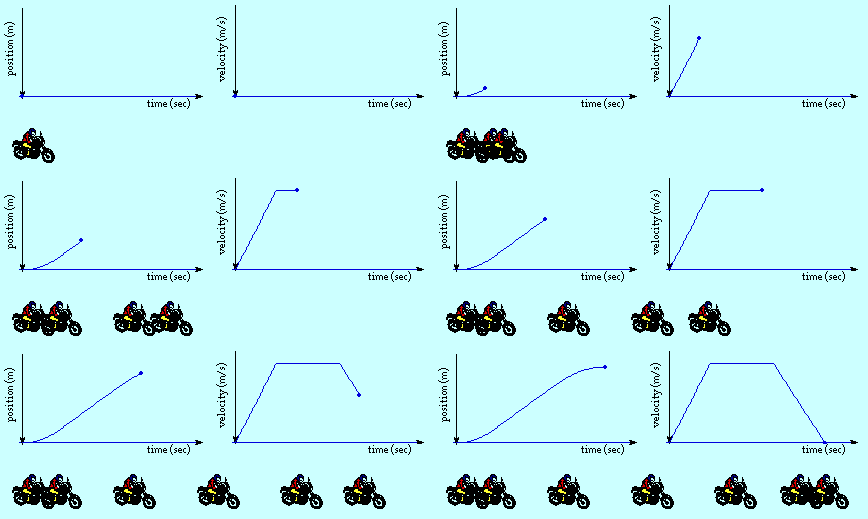
This is a challenging problem that involves the analysis of a three-stage motion. It's a motion about Alex who's dirt biking. And what we notice is he starts from rest and he accelerates at a given rate for a given time. Then he gets up to this speed and he maintains it for a while. And finally something crosses in front of him and he has to abruptly slow to a stop. So the three stages are the accelerating, the constant speeds of phase, and then the decelerating to a stop phase. And what we're asked to do is determine the average speed over the course of this entire motion, which involves several accumulation of time. And so what we're going to try to do is to find the total distance traveled and divide it by the time. And that's how you get an average speed. So most physics teachers I know of would begin the problem by organizing it and maybe even graphically representing it. I've included kind of an animation and a graph of what's going on. And what's of particular importance is probably that velocity-time graph that you see. So I'm going to kind of center my discussion around a velocity-time representation of the motion. And in the first stage, that's the upward slope line. And what's going on there is acceleration. And I know the slope of the line is 17.8. It happens for 1.56 seconds. So underneath that line is a triangle that has as its base 1.56 seconds. And I can calculate the height. It is the final velocity after the 1.56 seconds of acceleration. And so that would simply be the acceleration times the time. That gives me a velocity change. And so I know how tall that triangle is. And I can find the area underneath it, and that would be the distance traveled during the first phase of the motion. Now what I would have found from doing the first part of the problem I would have found that Alex's bike is going at 27.768 and something meters per second after the end of the first stage. Now he maintains this 27.768 meters per second speed for the next 9.47 seconds. So the next stage is a really easy one to analyze. It's a constant speed motion. The distance traveled is just represented by the area of a rectangle shown underneath that line. And it's just going to be the 27.768 meters per second times the 9.47 seconds. That gives me the distance during the second stage. Now during the last stage of the motion what we have is again a triangle. The downward sloping line for the braking to a stop has underneath it an area that's a triangle. And I can find the area of that triangle is 1.5 base height. Now the base is just simply 2.79 seconds. It's given to you. And the height we've already calculated to be that speed of 27.768 meters per second. So I'm going to go 1.5 base height and I'm going to get the value of that area. Now I've found 3 areas or 3 distances and I'm looking to calculate an average speed. Total distance traveled over a total time trip. So for the total distance traveled I just add up these 3 areas, these 3 distances. I get my total distance traveled. And I have in the statement of the problem 3 times which I'm going to add up. And I'll get an accumulation of time, a total time of travel. I just do the ratio of total distance traveled and total time of travel. And that gives me my average speed.
Solution
23.4 m/s
Habbits of an Effective Problem Solver
- Read the problem carefully and develop a mental picture of the physical situation. If necessary, sketch a simple diagram of the physical situation to help you visualize it.
- Identify the known and unknown quantities in an organized manner. Equate given values to the symbols used to represent the corresponding quantity - e.g., \(v_o = \units{0}{\unitfrac{m}{s}}\); \(a = \units{4.2}{\unitfrac{m}{s^2}}\); \(v_f = \units{22.9}{\unitfrac{m}{s}}\); \(d = \colorbox{gray}{Unknown}\).
- Use physics formulas and conceptual reasoning to plot a strategy for solving for the unknown quantity.
- Identify the appropriate formula(s) to use.
- Perform substitutions and algebraic manipulations in order to solve for the unknown quantity.
Read About It!
Get more information on the topic of 1D Kinematics at The Physics Classroom Tutorial.