1D Kinematics Legacy Problem #16 Guided Solution
Problem*
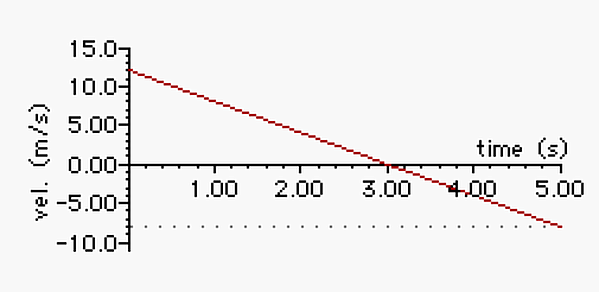
After a long soccer practice down at the neighborhood soccer fields, Suzie begins walking up the steep hill towards her home. She gives her soccer ball a kick up the hill and continues walking towards it, meeting the ball as it is rolling back down. The velocity-time graph below depicts the motion of the ball. Use the graph to answer the following questions.
- At what time did the ball change directions and begin rolling back down the hill?
- What is the acceleration of the ball as it rolls up the hill? down the hill?
- How far up the hill did the ball roll before it began to roll back down?
- Determine the total distance traveled by the ball during the 5.00 seconds - both the distance up the hill and down the hill.
- How far up the hill did Suzie walk between the time when she kicked the ball and the time she met up with the ball (at 5.0 seconds)?
Audio Guided Solution
Oftentimes what makes a physics problem difficult is that it's not only mathematically difficult, but also conceptually difficult as well. And that's the case here in this problem about a soccer ball rolling up a hill and then back down. This motion is being represented by a velocity time graph depicting how the velocity of the object is changing over the course of time. Now you need to be able to picture this ball rolling up a hill and then rolling back down, and if you can think of its velocity as being positive while rolling up and negative while rolling down, there's going to be a point in time in which the velocity is going to change from a positive to a negative value. After all, the ball slows down rolling up, and so you would expect that the velocity would gradually decrease and decrease and decrease until finally it reaches zero, at which point it would turn around and move back down. So we notice that this line crosses the axis at 3.0 seconds, and it's that point at 3.0 seconds that represents the time at which the ball changes direction. So the first conceptual hurdle you have to get over in this question is recognizing that that line crosses the axis when the ball changes direction. Now, the mathematical aspect of this problem demands that you be able to calculate some slopes and be able to calculate some areas. Slope's just going to be a rise-per-run ratio, and area's going to be an area between the line and the time axis, and it's going to be a triangular area that you have to calculate. So in Part B, when they ask, what's the acceleration of the ball as it rolls up the hill and then as it rolls down the hill, you simply need to find the slope of that line. It doesn't matter what two points you pick, because the slope is a constant slope. It's not changing how much it rises or how much it slopes downwards over the course of those five seconds. So you can pick the 2.0 seconds in 12 meters per second, and then 3 seconds in 0 meters per second, and do a rise-per-run there, and that's a rise of negative 12 for a run of 3, and that gives you a negative 4.0 meters per second per second acceleration. You get the same value if you pick the point at 5 seconds. Now, the next three questions have to do with distances, and again, it's conceptually difficult. In Part C, you're trying to find how far up the hill or what distance up the hill the ball rolls until it gets to that 3-second mark and begins to roll back down. You're trying to find the area of a triangle that has as its height 12.0 meters per second and as its base 3 seconds, so you're going to 1 half base times height. 1 half the base of 3 times the height of 12. That's 3 seconds times 12.0 meters per second. That would give you an area of 18 meters, and then the next question, determine the total distance traveled by the ball during the entire 5 seconds. So don't just do the 18 meters for the first 3 seconds, but find an additional distance traveled from 3 to 5 seconds and add that on to the 18 meters for the first 3 seconds. Again, we have a little triangle that's located beneath the time axis. It has a base of 2 seconds, 3 to 5 seconds, and it has a height that looks like negative 8 meters per second from 0 down to negative 8. Now what you're going to have to do is 1 half base height, 1 half base of 2 times the height of negative 8, and that gives you a negative 8 meter area. That negative simply means it rolled in the negative direction. The distance it rolled was 8 meters. So you have to take the 8 and add it on to the 18, and when you do that, you end up getting 26.0 meters as your answer for Part D. Now for Part E, the hardest part of this question. In Part E, you have to have a good conceptual grip again on what's going on. Suzy kicks the ball, rolls 18 meters up the hill, and it rolls back down 8 meters, and it's at that point, 5 seconds, that Suzy reaches the ball. Why did Suzy reach it? Well, because after she kicked it at 0 seconds, she continues walking up the hill, and she meets it on the way back down, according to the problem statement here. So it rolled 18 meters up and then 8 meters back down. When Suzy finally touches it again, Suzy must have walked 10 meters to make up the difference between that 18 up the hill and the 8 meters down the hill. So the answer to Part E is 10 meters.
Solution
- 3.00 s
- -4.00 m/s/s
- 18.0 m
- 26.0 m
- 10.0 m
Habbits of an Effective Problem Solver
- Read the problem carefully and develop a mental picture of the physical situation. If necessary, sketch a simple diagram of the physical situation to help you visualize it.
- Identify the known and unknown quantities in an organized manner. Equate given values to the symbols used to represent the corresponding quantity - e.g., \(v_o = \units{0}{\unitfrac{m}{s}}\); \(a = \units{4.2}{\unitfrac{m}{s^2}}\); \(v_f = \units{22.9}{\unitfrac{m}{s}}\); \(d = \colorbox{gray}{Unknown}\).
- Use physics formulas and conceptual reasoning to plot a strategy for solving for the unknown quantity.
- Identify the appropriate formula(s) to use.
- Perform substitutions and algebraic manipulations in order to solve for the unknown quantity.
Read About It!
Get more information on the topic of 1D Kinematics at The Physics Classroom Tutorial.