1D Kinematics Legacy Problem #31 Guided Solution
Problem*
It's breakfast time and Mr. H entertains himself once more by watching the daily beetle race across the 35.7-cm length of the Wheaties box top. Angie the beetle typically averages 3.77 mm/s and Bessie the beetle averages 4.78 mm/s. If Bessie gives Angie a 5.4 cm head start, then which beetle wins and by what distance?
Audio Guided Solution
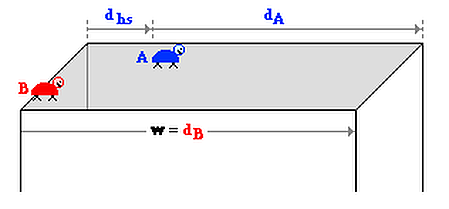
Now this is a very difficult problem and one in which you definitely want to practice the habits of a good problem solver. Those habits begin by careful reading of the problem and a visualization of the problem. And I'm relatively certain that not a single physics teacher I know of would ever start this problem without actually diagramming what's going on because it's very complicated to get two objects moving at different speeds and different distances and so it just begs a diagram. You'll notice I've included a diagram here. This is how I perceive the problem as I read it. Two beetles on a box top. You see the top of the box there. You see what I call beetles there beginning their motion. Beetle A and Beetle B or Beetle Angie and Beetle Bessie are doing their usual race and they're going different distances because there's a head start distance. I've labeled that as a DHS here, it's 5.4 centimeters. The total width of the box, which is the distance that Beetle B goes, is 35.7 centimeters. The distance that Beetle A goes is just simply the 35.7 minus the 5.4, the 30.3 centimeters. So I do know the distances that the two beetles have to move before they get to the end of the box. And what I know is they're traveling at different speeds and I have to be very careful here and give attention to units because while the distances are in centimeters, the speeds are in millimeters per second. So I should do a translation there. For Beetle A, the VA equals 0.377 centimeters per second. That's going to give me consistent units. And for Beetle Bessie, the VB is 0.478 centimeters per second. Now it's constant speed motion across the box and what I want to know is who wins, Angie or Bessie, and I want to know by how much does the winning beetle win. So there's numerous ways you can approach this and probably the simplest one to explain is this one. You have this equation, D equals VT. You can take that equation and you can find the time it takes the Beetle A, Angie, to travel its 30.3 centimeters to the end of the box. You can use the same equation but a different speed to find the time it takes Beetle Bessie to travel from one end to the other end, 35.7 centimeters. Get the two times. Now the one that gets to the end of the box in the least amount of time, well, that's the winner. And here it will end up being Bessie. So Bessie wins, actually passes Angie and gets to the end of the box first. Now what you're going to do is take the time for Bessie to get to the end of the box. You're going to find out how far Angie travels in that amount of time. So that's, again, using the equation D equals V times T with Angie's speed and the time it takes for Bessie to get to the end of the box. Now you get that number and now you can find out how far Angie is from the end of the box. Because Angie starts 5.4 centimeters ahead and then travels another distance. And if you subtract the distance traveled and the 5.4 centimeters from the width of the box at 35.7 centimeters, you'll find out how far Angie is from the end of the box when at the instant that Bessie gets to the finish line. That's all there is to it.
Solution
Bessie wins by 2.1 cm
Habbits of an Effective Problem Solver
- Read the problem carefully and develop a mental picture of the physical situation. If necessary, sketch a simple diagram of the physical situation to help you visualize it.
- Identify the known and unknown quantities in an organized manner. Equate given values to the symbols used to represent the corresponding quantity - e.g., \(v_o = \units{0}{\unitfrac{m}{s}}\); \(a = \units{4.2}{\unitfrac{m}{s^2}}\); \(v_f = \units{22.9}{\unitfrac{m}{s}}\); \(d = \colorbox{gray}{Unknown}\).
- Use physics formulas and conceptual reasoning to plot a strategy for solving for the unknown quantity.
- Identify the appropriate formula(s) to use.
- Perform substitutions and algebraic manipulations in order to solve for the unknown quantity.
Read About It!
Get more information on the topic of 1D Kinematics at The Physics Classroom Tutorial.