1D Kinematics Legacy Problem #14 Guided Solution
Problem*
Marcus Tardee is driving his friends to school. With the start of school being only minutes away, he is unfortunately following a slow garbage truck. The truck finally turns down a side street and Marcus accelerates to a much more customary speed. The velocity-time graph below represents his motion.
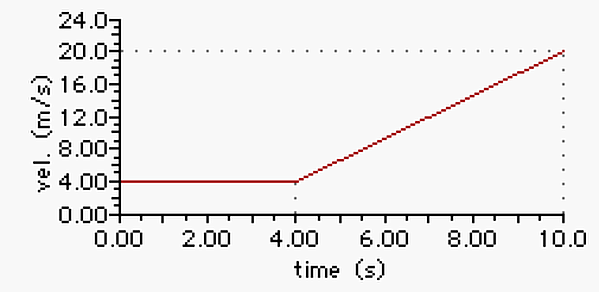
Use the graph to answer the following questions.
- How fast was Marcus traveling while following the garbage truck?
- Determine the distance traveled during the first 4.0 seconds represented on the graph.
- Determine the acceleration of the car once the garbage truck turned onto the side street.
- Determine the distance traveled by the car during the last 6.0 seconds of motion
Audio Guided Solution
Here we have the motion of a car being represented by a velocity-time graph. And on this velocity-time graph, what we're doing is we're showing how the velocity of the car is changing or not changing over the course of time. So while Marcus is following the garbage truck, the velocity is remaining a constant value of 4 meters per second up until 4 seconds on the graph, at which time we start to notice slope representing Marcus's car speeding up or accelerating over the course of 6 more seconds from 4.00 to 10.00 seconds. So what we're being asked is, first of all, how fast is Marcus traveling while following the garbage truck? You just have to recognize that that horizontal line represents the following the garbage truck phase of Marcus's motion. And during that first 4 seconds, he's moving 4 meters per second. And if asked what distance he travels, you have to recognize that a constant speed of 4 meters per second for 4 seconds would result in 16 meters of distance traveled during that time period. If you're asked what the acceleration is whenever you have one of these types of graphs, they're asking you a question about a slope, a rise per run. And finding the slope means you're going to do a rise per run ratio, or a delta y over delta x, for two points on the line, the most strategic points being the point at 4 seconds and the point at 10 seconds, since those coordinates are easily read. So at 4 seconds, our velocity is 4 meters per second, and at 10 seconds, it's 20 meters per second. That's a change in velocity from 4 to 20, or a change by 16, and that change of 16 meters per second occurs over the course of 6 seconds of time. The rise per run, or delta y over delta x ratio, is 16 over 6. When you do the math on that, it comes out to be 2.66 repeating, or 2.67 meters per second per second. The final question is a distance question. Whenever you're given one of these graphs, and you're asked a question about distance or displacement, you could translate that to mean find the area between the line on the graph, and the time axis is bound by the two vertical lines taken at the two extremes of time, 4 seconds and 10 seconds. That's one way to do it. In this case, you're finding the area of a trapezoid. Now, if you use the little link right here on this page, it will take you back to a page from the physics classroom tutorial. I highly recommend it if you're having troubles calculating areas. But real quickly, the way I would do that is I would find the area of the trapezoid by breaking it up simply into a rectangle on the bottom, with a triangle on top of that rectangle. That rectangle is 4 meters per second high, and stretches across for 6 seconds. So, its area is 24 meters. 4 meters per second times 6 seconds. And then on top of that is a triangle that has a height of 4 to 20, which is a height of 16 meters per second. Not 20, but 16 meters per second, because that's how high it extends from 4 to 20. And it has a base of 6 seconds, so I go 1 half base height. 1 half the 6 seconds times the height of 16 meters per second. That gives me the area of that triangle of 48 meters. And then I just add that to the 24 meters of the rectangle underneath. It gives me the total trapezoid area. Now, some of you are real sophisticated in your mathematics. You know other ways to find trapezoidal areas using a 1 half base times the height 1 plus height 2. You might know it in other forms, but essentially that's what you're doing. 1 half base times h1 plus h2. And that gives you the same 72 meters distance. And then still others of you are going to look at this and say, well, in those last 6 seconds, isn't this person averaging 12 meters per second? You're exactly right. The average of 4 and 20 is 12 meters per second. And all you'd have to do is go 12 meters per second times the time of 6 seconds. You'd get 72 meters that way as well. Anyways, the skin of the cat here. Just pick your favorite method.
Solution
- 4.0 m/s
- 16.0 m
- 2.67 m/s/s
- 72.0 m
Habbits of an Effective Problem Solver
- Read the problem carefully and develop a mental picture of the physical situation. If necessary, sketch a simple diagram of the physical situation to help you visualize it.
- Identify the known and unknown quantities in an organized manner. Equate given values to the symbols used to represent the corresponding quantity - e.g., \(v_o = \units{0}{\unitfrac{m}{s}}\); \(a = \units{4.2}{\unitfrac{m}{s^2}}\); \(v_f = \units{22.9}{\unitfrac{m}{s}}\); \(d = \colorbox{gray}{Unknown}\).
- Use physics formulas and conceptual reasoning to plot a strategy for solving for the unknown quantity.
- Identify the appropriate formula(s) to use.
- Perform substitutions and algebraic manipulations in order to solve for the unknown quantity.
Read About It!
Get more information on the topic of 1D Kinematics at The Physics Classroom Tutorial.