1D Kinematics Legacy Problem #15 Guided Solution
Problem*
The velocity-time graph below represents the motion of a car on a city street.
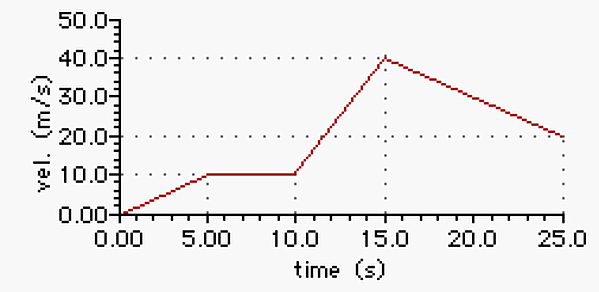
Use the graph to determine the acceleration values of the car at ...
- 1.4 seconds.
- 6.8 seconds.
- 11.6 seconds.
- 17.6 seconds.
Audio Guided Solution
Oftentimes, a beginning student of physics will have tremendous difficulty on a physics problem. It's just simply because they're missing a very small point. And that might be the case on this problem. Typically, when a student in this situation learns of the idea, they're just going to scratch their head saying, I wish I knew that ahead of time. It would have saved me a lot of anguish. Here we have a velocity time graph for four stages of a car's motion from 0 to 5 seconds, 5 to 10, 10 to 15, and 15 to 25 seconds. What we're asked to do is calculate four different accelerations. And you'll note that the times that they give you are nasty little times, 1.4 seconds, 6.8 seconds, et cetera. It'd be much easier if they said, find the acceleration from 0 to 5, and 5 to 10 seconds, and from 10 to 15 seconds, and giving you a time period instead of an instantaneous time. But the fact is that if you look at each of these times they gave you, and if you look at the graph, you'll notice that the lines are straight during these periods of time, straight diagonal or straight horizontal. So for 1.4 seconds, it's going to be the same acceleration as it is from 0 to 5 seconds, as it is at 2.9 seconds or 3.8 seconds. Just simply find the acceleration from 0 to 5 seconds. That means do a slope calculation. Take two points on that line, the most obvious being the 0.00 and the 0.5 seconds, 10 meters per second. And do a delta y per delta x, a delta v per delta t. That gives you an acceleration on a velocity time graph. And it ends up being a rise of 10 and a run of 5. 10 meters per second per 5 seconds, you get 2 meters per second per second. Now, at the 6.8 second mark, that's right on the horizontal line there. Easy slope calculation, 0 meters per second per second. And it wouldn't matter whether they said 6.8 seconds or 9.2 seconds or any instant of time along there, since the acceleration is a constant value of 0. It's just going to be 0 everywhere along that line. And then again for part C, 11.6 seconds lies on the straight diagonal line that stretches from 10 seconds to 15 seconds. So find the slope of the line. Be cautious here that you're calculating an acceleration by doing a rise per run or a delta y over delta x. Don't just jump over to 15 seconds and grab the coordinate 40 meters per second and do y divided by x. You want to do a delta y, a change in velocity divided by a change in time. So that change goes from 10 up to 40, a change of 30 meters per second over a time change of 5 seconds. And that gives you a delta v per delta t ratio of 6 meters per second. Now, in the last stage, you're calculating, again, an acceleration of that straight diagonal line. It wouldn't matter if it was 17.6 seconds or 21.8 seconds. Just find the slope of that line. And that line slopes from 40 down to 20. That's a negative slope. It goes down negative 20 meters per second. And the line runs across for 10 seconds. So it's negative 20 meters per second divided by 10 seconds. And that's negative 2 meters per second per second.
Solution
- 2.0 m/s/s
- 0.0 m/s/s
- 6.0 m/s/s
- -2.0 m/s/s
Habbits of an Effective Problem Solver
- Read the problem carefully and develop a mental picture of the physical situation. If necessary, sketch a simple diagram of the physical situation to help you visualize it.
- Identify the known and unknown quantities in an organized manner. Equate given values to the symbols used to represent the corresponding quantity - e.g., \(v_o = \units{0}{\unitfrac{m}{s}}\); \(a = \units{4.2}{\unitfrac{m}{s^2}}\); \(v_f = \units{22.9}{\unitfrac{m}{s}}\); \(d = \colorbox{gray}{Unknown}\).
- Use physics formulas and conceptual reasoning to plot a strategy for solving for the unknown quantity.
- Identify the appropriate formula(s) to use.
- Perform substitutions and algebraic manipulations in order to solve for the unknown quantity.
Read About It!
Get more information on the topic of 1D Kinematics at The Physics Classroom Tutorial.