1D Kinematics Legacy Problem #35 Guided Solution
Problem*
Hayden and Matthew are riding around the neighborhood on their scooters. Hayden is at rest when Matthew passes him moving at a constant speed of 0.37 m/s. After 1.8 seconds, Hayden decides to chase after Matthew, accelerating at 0.91 m/s/s. How much time must Hayden accelerate before he is side-by-side with Matthew?
Audio Guided Solution
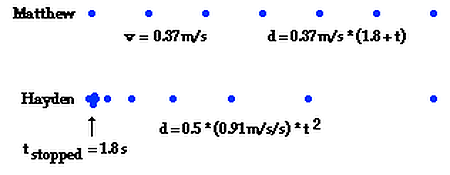
This is a very difficult problem, both mathematically and conceptually. Conceptually, you can make the problem a little bit easier if you take your time to read it carefully and to try to visualize the situation, possibly even diagramming it, and writing down what you know and what you're looking for, maybe even constructing a graph, all in an effort to get a conceptual grip on what's going on in this problem. Mathematically, you're going to have to have some good mathematical skills or calculator skills in order to solve this one. The problem is about two boys in the neighborhood. One is at rest, and the second boy is moving along the sidewalk at a constant speed and passes the first boy. Matthew moves at a constant speed of 0.37 meters per second, and 1.8 seconds after he passes Hayden, Hayden says, hey, I'm going to try to catch up with Matthew. So if you're picturing this as a dot diagram, what you're going to picture is Matthew's dots are uniformly spaced apart, moving at constant speed, and the distance that he travels would be expressed by an equation d equal v times t. Now for Hayden, Hayden stays at rest, and so you're going to see a glob of dots for 1.8 seconds, and finally Hayden says, hey, I'm going to catch up, and he begins to accelerate, so now you'd see the dots begin to space themselves further and further apart. In terms of a graph, you'd represent Hayden motions by a horizontal line at 0 meters per second, and then a diagonal of Matthew's would be a horizontal line at 0.37 meters per second for the entire time. Now, here's the real complication. The time at which Hayden covers distance, or is moving, is different than the time at which Matthew's moving. Matthew moves for a time that's 1.8 seconds longer than the time that Hayden moves. We want to figure out how much time Hayden is accelerating before he gets side by side, so Hayden's time of motion, we're just going to call t, and that's going to be the answer. Now Matthew's time of motion is going to be 1.8 seconds plus the t. It's an extra amount of time because Hayden takes a while before he finally starts to accelerate, so for Matthew's distance, it's 0.37 times the quantity 1.8 plus t, where t is the time that Hayden's moving, and for Hayden's distance, the distance is given by the equation d equals v not t, the original t, plus 1.8 t squared, where the original velocity for Hayden is 0. So I simply say his distance is 1.8 times 0.91 times t squared. I can simplify that to 0.455 t squared. So now what I have is two expressions for distance, one for Matthew, one for Hayden, and we want to know at what time are they side by side. In other words, at what time have they moved the same distance? And I can calculate that if I set the two expressions for distance equal to each other. So I write myself an equation that goes like this, 0.37 times the quantity 1.8 plus t, all is equal to 1 half times 0.91 t squared. So I've set Matthew's distance equal to Hayden's distance, and now I need to solve for time. Now what complicates the problem is the solution for the time ends up resulting in a quadratic function. So you need to either use a quadratic equation or use your calculator skills in order to solve for time. You're going to get two times. One of them is the negative time, and the other one is the positive time. You, of course, want the positive time. It comes out for me to be about 1.6829, thereabouts, and then you need to round that to the proper number of significant figures, which ends up being about 1.7 seconds.
Solution
1.7 s (rounded from 1.68 s)
Habbits of an Effective Problem Solver
- Read the problem carefully and develop a mental picture of the physical situation. If necessary, sketch a simple diagram of the physical situation to help you visualize it.
- Identify the known and unknown quantities in an organized manner. Equate given values to the symbols used to represent the corresponding quantity - e.g., \(v_o = \units{0}{\unitfrac{m}{s}}\); \(a = \units{4.2}{\unitfrac{m}{s^2}}\); \(v_f = \units{22.9}{\unitfrac{m}{s}}\); \(d = \colorbox{gray}{Unknown}\).
- Use physics formulas and conceptual reasoning to plot a strategy for solving for the unknown quantity.
- Identify the appropriate formula(s) to use.
- Perform substitutions and algebraic manipulations in order to solve for the unknown quantity.
Read About It!
Get more information on the topic of 1D Kinematics at The Physics Classroom Tutorial.