1D Kinematics Legacy Problem #11 Guided Solution
Problem*
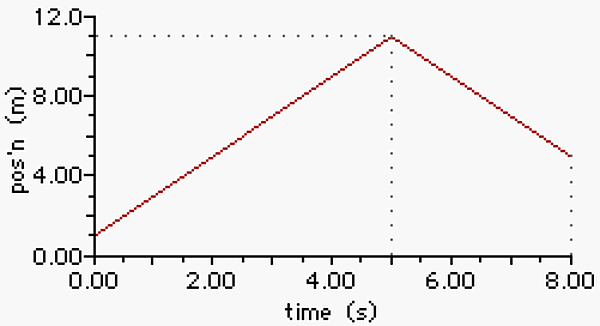
Mr. H is preparing to show the class a Strobe demonstration when he realizes that his absent-mindedness has struck once more. He left the strobe on the counter in the back of the lab after the last class period. Starting 1.0 meter from the front of the room, Mr. H walks quickly to the back of the lab, picks up the strobe and returns to the middle of the classroom. The position-time graph below represents his motion. Use the graph to answer the next several questions.
- What is the total distance walked by Mr. H during these 8.0 seconds?
- What is the average speed of Mr. H during these 8.0 seconds?
- What is the average velocity of Mr. H during these 8.0 seconds?
- How fast did Mr. H walk during the first 5.0 seconds?
- How fast did Mr. H walk during the last 3.0 seconds?
Audio Guided Solution
There are many ways to describe the motion of an object, and in this case, we have the motion of a physics teacher being described with a position time graph. And in this position time graph, what we notice is there's a line sloping upwards for the first five seconds, and then sloping downwards for the last three seconds, representing a teacher who walks from the front of the classroom to the back of the lab, and then comes back up to the middle of the classroom. So the upward sloping line is the motion of the teacher from the front of the classroom to the back of the lab, and the downward sloping line is for the return of that teacher in the middle of the room. We're asked five questions about this object's motion. First, we're asked, what's the total distance walked for the entire eight seconds? So we have to conceptualize what's going on in this graph. We have a teacher for five seconds changing his position from a one meter location, one meter from the front of the room, to an eleven meter position, eleven meters from the front of the room. Now that's a position change from one to eleven meters. That's a ten meter position change in five meters, or in five seconds. And then the teacher walks forward, but not all the way forward, but forward to the five meter mark. That's from eleven meters to five meters in the last three seconds. That's six meters in three seconds. Now we have five questions to answer. The first one is, what's the total distance walked by the coach? And that's just simply the ten meters to the back of the room, plus the six meters to the front of the room. That's sixteen meters total. The next question, what's the average speed during these eight seconds? Well, that's just simply the ratio of the distance to the time, the total distance traveled to the total time. And that's just simply sixteen meters over eight seconds, or two meters per second. Now the next question is distinctly different. What's the average velocity for the eight seconds? So what we need to do is calculate an overall displacement of the coach, who started one meter from the front of the room and finished six meters from the front of the room, or five meters from the front of the room. Well, that's an overall displacement from one to five, or a total displacement of four meters. That takes place in eight seconds. So the coach has displaced, or the teacher has displaced himself four meters in eight seconds. That gives you an average velocity of point five meters per second. Finally, I want to know how fast he walked in the first five seconds and then in the last three seconds. Those are distance to time ratios. So he walked ten meters in five seconds. That's two meters per second. And then walked six meters in three seconds. That also is two meters per second.
Solution
- 16 m
- 2.0 m/s
- 0.5 m/s
- 2.0 m/s
- 2.0 m/s
Habbits of an Effective Problem Solver
- Read the problem carefully and develop a mental picture of the physical situation. If necessary, sketch a simple diagram of the physical situation to help you visualize it.
- Identify the known and unknown quantities in an organized manner. Equate given values to the symbols used to represent the corresponding quantity - e.g., \(v_o = \units{0}{\unitfrac{m}{s}}\); \(a = \units{4.2}{\unitfrac{m}{s^2}}\); \(v_f = \units{22.9}{\unitfrac{m}{s}}\); \(d = \colorbox{gray}{Unknown}\).
- Use physics formulas and conceptual reasoning to plot a strategy for solving for the unknown quantity.
- Identify the appropriate formula(s) to use.
- Perform substitutions and algebraic manipulations in order to solve for the unknown quantity.
Read About It!
Get more information on the topic of 1D Kinematics at The Physics Classroom Tutorial.