1D Kinematics Legacy Problem #17 Guided Solution
Problem*
Jeremy has recently taken up snowboarding as a hobby. He is practicing making smooth turns while traveling up sloped inclines. The velocity-time graph below depicts his motion traveling up an embankment and part-way down. Use the graph to answer the following questions.
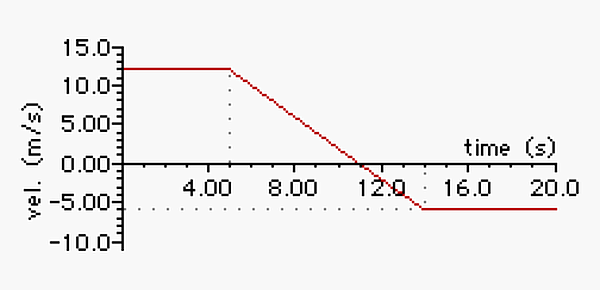
- Determine Jeremy's acceleration at 8.0 seconds.
- Determine the distance Jeremy traveled from 0.0 to 5.0 seconds.
- At what time did Jeremy begin to travel back down the embankment?
Audio Guided Solution
In this problem, the motion of a snowboarder is being represented by a velocity-time graph. You kind of have to begin by getting a conceptual idea of what's going on with the motion. Jeremy, the snowboarder, is practicing his snowboarding. As he does, he's kind of traveling along at a constant velocity for five seconds, and then he starts to go up a hill, which causes his speed, or his velocity, to diminish or decrease. Over the course of six seconds, it's decreasing from the original 12 meters per second to 0 meters per second. At 11 seconds, he kind of turns around and begins to slide back down. You'll notice that he increases his speed, or he increases the magnitude of his velocity, from 0 to this negative 6 meters per second over the course of the next three seconds, at which time he begins to maintain a steady velocity again of 16, of negative 6 meters per second. So now, with that as your conceptual understanding of the motion, you have to begin to approach the questions, and there's a couple of types of questions being asked here. What's the acceleration? What's the distance traveled? And then finally, a time question is being asked. And to get those acceleration-type questions on a velocity-time graph, it demands that you calculate a slope. And this is kind of a nasty way to ask the question here, apparently. It says, what's the acceleration at 8 seconds? It's just kind of tempting you to try to get an x, y coordinate or a t, v coordinate for the 8.0 second mark. And it simply isn't necessary, because 8 seconds lies along that line that stretches from 5 seconds to 14 seconds. And so all you need to do is calculate the slope of that line, and you'd have the slope at 8 seconds, because the slope there is a constant slope value. So you could try to struggle and get the coordinate values for 8 seconds, but it would be much easier to pick two coordinates that are clearly known, like 5 seconds in 12 meters per second, and then 11 seconds in 0 meters per second, or alternatively, 14 seconds in negative 6 meters per second. Once you get two clearly known coordinate values, you can do a delta v over delta t, a rise over run, or a y coordinate change over an x coordinate change. And it comes out to be a ratio of negative 2 meters per second per second. The next question is a distance question. It's actually a relatively easy distance question. They ask you, what's the distance traveled from 0 to 5 seconds, during which time Jeremy is maintaining a constant speed of 12 meters per second for 5 seconds. So you're just going to take that speed of 12 meters per second and multiply it by the 5 seconds. Essentially what you're doing is calculating the area of a little rectangle below the line on the graph for the first 5 seconds, and it comes out to be 60.0 meters. Finally, part C, at what time did Jeremy begin to travel back down the embankment? He's traveling up the embankment from about 5 seconds to 11 seconds, and then back down. It's at 11 seconds that we see the velocity change from a positive to a zero. It's during that transition time in 11 seconds that Jeremy is changing his direction from up to down. So pick 11 seconds there for that last question.
Solution
- -2.00 m/s/s
- 60.0 m
- 11.0 s
Habbits of an Effective Problem Solver
- Read the problem carefully and develop a mental picture of the physical situation. If necessary, sketch a simple diagram of the physical situation to help you visualize it.
- Identify the known and unknown quantities in an organized manner. Equate given values to the symbols used to represent the corresponding quantity - e.g., \(v_o = \units{0}{\unitfrac{m}{s}}\); \(a = \units{4.2}{\unitfrac{m}{s^2}}\); \(v_f = \units{22.9}{\unitfrac{m}{s}}\); \(d = \colorbox{gray}{Unknown}\).
- Use physics formulas and conceptual reasoning to plot a strategy for solving for the unknown quantity.
- Identify the appropriate formula(s) to use.
- Perform substitutions and algebraic manipulations in order to solve for the unknown quantity.
Read About It!
Get more information on the topic of 1D Kinematics at The Physics Classroom Tutorial.