1D Kinematics Legacy Problem #12 Guided Solution
Problem*
The position-time graph below represents the motion of two students - Mac (in red) and Tosh (in blue) - as they enter and exit the school library during a passing period.
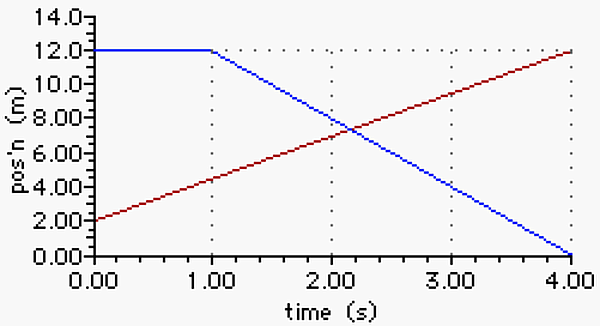
Use the graph to determine the speeds at which the two students move. (Ignore any stationary periods of time.) Then determine how much faster the fastest student moves than the slower student.
Audio Guided Solution
Here we have the motion of two students being represented by a position time graph. The line that is red on the graph is representing Mac, who is walking in the forward direction and is away from the zero position mark. He starts walking at zero seconds and over the course of four seconds he goes from two meters to twelve meters. That's a displacement of Mac of ten meters in four seconds. So what we could say about Mac is Mac is walking ten meters per four seconds or 2.5 meters every second. What I've done there is calculated the slope of the red line and on a position time graph the slope is equal to the velocity. Now I'm going to focus on the blue line which is representative of Tosh's motion. Now initially for the first second that line is horizontal meaning that Tosh isn't even moving at all. But once he starts moving at one second he moves from a position of twelve meters to a position of zero meters. That's a displacement of twelve meters in the negative direction over the course of just three seconds of motion. Since the first second he wasn't actually moving. So we're asked how fast does he move? Well when he's moving he's moving twelve meters in three seconds and that's a speed of four meters per second. The fact that that slope is negative for the blue line for Tosh simply means that he's walking in the negative direction. We might say it's a negative velocity of negative four meters per second. But when we're asked questions about how fast or speed we ignore the plus minus nature because speed is a scalar. So we have answers to the first question which is determine the speeds of the two students. One of them is moving four meters per second and the other 2.5 meters per second. And the follow-up question is how much faster is the fastest student moving than the slower student? And there we just simply have to take a difference in speed. One being four and the other being 2.5 and we get 1.5 meters per second.
Solution
- Mac's speed: 2.5 m/s
- Tosh's speed: 4.0 m/s
- Difference: 1.5 m/s
Habbits of an Effective Problem Solver
- Read the problem carefully and develop a mental picture of the physical situation. If necessary, sketch a simple diagram of the physical situation to help you visualize it.
- Identify the known and unknown quantities in an organized manner. Equate given values to the symbols used to represent the corresponding quantity - e.g., \(v_o = \units{0}{\unitfrac{m}{s}}\); \(a = \units{4.2}{\unitfrac{m}{s^2}}\); \(v_f = \units{22.9}{\unitfrac{m}{s}}\); \(d = \colorbox{gray}{Unknown}\).
- Use physics formulas and conceptual reasoning to plot a strategy for solving for the unknown quantity.
- Identify the appropriate formula(s) to use.
- Perform substitutions and algebraic manipulations in order to solve for the unknown quantity.
Read About It!
Get more information on the topic of 1D Kinematics at The Physics Classroom Tutorial.