1D Kinematics Legacy Problem #33 Guided Solution
Problem*
Ima Rushin can travel from Milwaukee Avenue to the school entrance gate at a constant speed of 22.5 m/s when the lights are green and there is no traffic. On Wednesday, Ima is stopped by a red light at Landwehr Road. She decelerates at -3.95 m/s/s, waits for 45.0 seconds before the light turns green and accelerates back up to speed at 4.91 m/s/s.
- Determine the total time required to decelerate, stop and accelerate back up to speed.
- Determine the amount of time the red light costs the driver (compared to if the car had not been stopped by the red light).
Audio Guided Solution
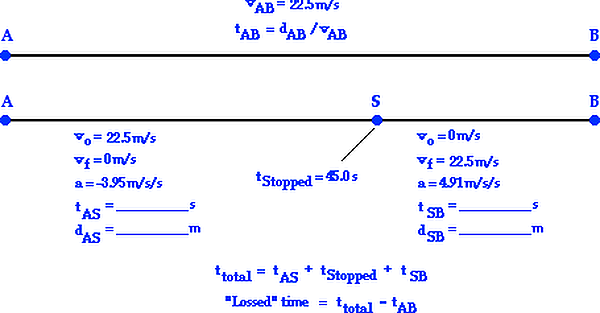
Now, this is a very difficult problem, and like any difficult problem, it's imperative that you practice the habits of good problem solvers. You read the problem carefully, you get a good middle picture of what's going on, you identify known and unknown values, and before you ever start to pick up your calculator, you just think through a plot out of strategy for getting from the known information to the unknown. I'll model that here. I read about Ima who's rushing her way to school, and normally when there's no traffic and no lights, she's able to go from, let's just say, point A to point B in so much time but then on one given day. What we know is that Ima sees a yellow light and has to slow down to a stop, then wait 45 seconds, and then speed back up to her original speed of 22.5. So we're contrasting two different types of motion, one which is just a constant speed motion, 22.5 meters per second along the roadway, and the other one which is simply a three-stage motion of slowing down, then stopping and staying stopped, and then speeding back up to speed. We want to find the times it takes for Ima to do the constant speed motion versus the slowing down, stopping and waiting, and speeding up. Now you'll notice that I've depicted this with a diagram, and you see two line segments and the top one is labeled A to B, and that simply is representing Ima going at constant speed from A to B, and then you'll notice the bottom one is A to S to B, and some information is given there about the original speed and the final velocity during the slowing down stage from A to S, and the acceleration during that slowing down stage, and a couple of things I really need to figure out is how much distance it is, and most importantly, how much time that is, because this is all about time. And then she remains stopped for 45 seconds at point S, and then she speeds back up from S to this imaginary point B, and that points A and B is just A being when she begins to brake and B being when she finally gets back up to speed, and we want to find the total time to do all that. And you'll notice I've listed again information for the going from S to B, the original velocity, the stopping point, the final velocity when she's finally back up to her speed of 22.5 meters per second, the acceleration there. Again, I want to find the time to go from S to B. Now I'm going to sum up these three times, A to S, and stopped at point S, and then S to B. I'm going to add up those three times, then I have to find the time it takes to go at this constant speed of 22.5 meters per second from point A to B without any braking, decelerating, whatever. So to do that, to find the time to go straight A to B, I'm going to need to know the distance A to B. And so I have to go back down and find, from my bottom diagram there, the braking distance and going from A to S, and the accelerating distance and going from S to B. I need to find those two distances, sum them together so I now know the total distance A to B. Then I can use it in my top equation to calculate the time to go from A to B nonstop. That's the strategy. That's how I would represent the problem visually. That's how I would identify my known and my unknowns, and how I would plot out my strategy. Now I need to execute. Now this is calculator time. You'll notice all the work here has been done in the initial stages of the problem when we practice having some good problem solver. Now let's simply pick up your calculator, pick out the equation, and go for it. And so the equations I'm going to use to find the stopping time is probably going to be A equal delta V over T, or VF equal VO plus AT. I need to find two T's, the T to go from A to S, and the T to go from S to B. And then I need to find some distances there, and the distances can be found typically using VF squared equal VO squared plus 2AT. And then once I get that, I'm going to have to do some summing and figure out the monotonal time, the slow down stop, and then the speed back up. And then go back up to the top diagram and find the time to go nonstop. And that's just the equation D equal VT, rearranged as T equal D divided by V. When you do your math, you end up getting 55.3 seconds is the cumulative time for I'm a Russian to go from A, slow down, stop at S, and then speed back up to B. And then you find out the time to actually go nonstop to be about 5.139 seconds, and you need to find the difference in the two times in order to find the so-called loss time, the time that cost the driver to actually slow down and stop for the line. That's all there is to it, but it's rather complicated. Give it a go.
Solution
- 55.3 sec
- 50.1 sec
Habbits of an Effective Problem Solver
- Read the problem carefully and develop a mental picture of the physical situation. If necessary, sketch a simple diagram of the physical situation to help you visualize it.
- Identify the known and unknown quantities in an organized manner. Equate given values to the symbols used to represent the corresponding quantity - e.g., \(v_o = \units{0}{\unitfrac{m}{s}}\); \(a = \units{4.2}{\unitfrac{m}{s^2}}\); \(v_f = \units{22.9}{\unitfrac{m}{s}}\); \(d = \colorbox{gray}{Unknown}\).
- Use physics formulas and conceptual reasoning to plot a strategy for solving for the unknown quantity.
- Identify the appropriate formula(s) to use.
- Perform substitutions and algebraic manipulations in order to solve for the unknown quantity.
Read About It!
Get more information on the topic of 1D Kinematics at The Physics Classroom Tutorial.