1D Kinematics Legacy Problem #34 Guided Solution
Problem*
A tortoise and a hare are having a 1000-meter race. The tortoise runs the race at a constant speed of 2.30 cm/s. The hare moves at an average speed of 1.50 m/s for 10.0 minutes and then decides to take a nap. After waking up from the nap, the hare recognizes that the tortoise is about to cross the finish line and immediately accelerates from rest with a constant acceleration of 0.500 m/s/s for the remaining distance of the race. If the tortoise wins by a hair (no pun intended), then what is the time in hours that the hare napped?
Audio Guided Solution
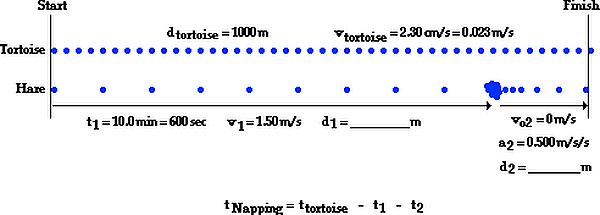
In physics there are problems which are basically mathematical exercises that use equations and the information needed to go into the equations is pretty immediately obvious. And then there are other problems which I would describe as true problems. Problems in which the solution from the beginning is not immediately obvious. It would require a considerable amount of thought and pre-analysis. And that particularly demand the use of the habits of an effective problem solver. And this problem here about a tortoise and a hare is what I would call a true problem. It's complicated by the fact that you have two objects that are moving. One, a tortoise that moves at a constant speed for a thousand meters. And the other, a hare, which has actually three stages to its motion. A constant speed motion at the beginning for ten minutes. And then an at rest motion for who knows how much time, a time that we're looking for. And then finally an accelerated motion that occurs over the last. So, remainder of the race. And what we wish to know here is if the tortoise, the one that goes at a constant speed, is to win the race by just a little bit. Then what time did the hare actually nap in order to lose the race? And so, like any problem that's complicated, I'm going to begin by reading it carefully and translating the verbal information into a diagram that I can sink my teeth into. And you'll notice that I've done that here and provided my own diagram. But that's something that you should learn how to do. You should start to read complicated problems and begin diagramming the problems. Now, I provided the diagram. In the top part of the diagram, we notice that the tortoise is moving at a constant speed of 2.3 centimeters per second for a thousand meters. And one of the things I'm going to want to figure out, since this problem is about time, is how much time does it take the tortoise to run that race? And so, that's a simple mathematics since there's no acceleration. I do have to give attention to units, though, because the centimeters per second speed does not match with the thousand meters distance. So, I'm going to convert the 2.3 centimeters per second to 0.0230 meters per second. And I'm going to find the time it takes the tortoise to run this thousand meters race. It's just d equals bt rearranged for t. So, t equals d over v. And I end up with 43,478.26 seconds for the tortoise to go these thousand meters. Now, I'm going to focus on the hair, the much more complicated diagram. The one that involves three stages, the middle stage of which is a resting stage. And I want to find the time it took the hair to rest, if the hair completes this entire race, in the same amount of time, minus unpochisimo seconds. And so, the way I'm going to do this is I'm first going to take this 10 minutes and I'm going to translate that into 600 seconds, consistent with the original speed given of 1.5 meters per second. I'm going to find how far the hair goes in 600 seconds. And that's easy mathematics again. d equals v times t, since there's no acceleration, or at least d equals average speed times t. So, 1.5 times 600 seconds is going to be 900 meters. So, the hair almost finishes the race, but then decides to take a nap. It's got 100 meters left to go and begins to nap and nap and nap. And finally, the tortoise passes him and the hair figures, oh, I better catch up and try to win this race once he wakes up. And so, he accelerates the last section of the race, the last 100 meters. Now, I know it's remaining 100 meters because it's 1,000 meters total and the hair goes 900 meters in the first 10 minutes. So, how much time does it take for the hair to wake up and travel these last 100 meters if the hair starts from rest and accelerates at 0.5 meters per second per second? Well, I can solve this one quite easily using the equation d equal the original t plus 1.5at squared, where the original velocity is the at rest velocity since the hair was sleeping. And so, I just go d equal 1.5at squared and I solve for t and I get 20 seconds. So, what we have is that the hair runs for 600 seconds, naps for some unknown amount of seconds, and then runs or accelerates the last 20 seconds to just barely lose a race. So, the time it takes the hair to do all of this has got to be equal to 43,478.26 seconds, the time it took the tortoise to do the whole thing. So, now I just set up an equation that says something like 43,478 seconds equal 620 seconds plus the time to nap and I solve for the napping time. I get about 42,858 seconds and then I divide by, I convert that to hours by dividing by 60 and by 60 again.
Solution
11.9 hr
Habbits of an Effective Problem Solver
- Read the problem carefully and develop a mental picture of the physical situation. If necessary, sketch a simple diagram of the physical situation to help you visualize it.
- Identify the known and unknown quantities in an organized manner. Equate given values to the symbols used to represent the corresponding quantity - e.g., \(v_o = \units{0}{\unitfrac{m}{s}}\); \(a = \units{4.2}{\unitfrac{m}{s^2}}\); \(v_f = \units{22.9}{\unitfrac{m}{s}}\); \(d = \colorbox{gray}{Unknown}\).
- Use physics formulas and conceptual reasoning to plot a strategy for solving for the unknown quantity.
- Identify the appropriate formula(s) to use.
- Perform substitutions and algebraic manipulations in order to solve for the unknown quantity.
Read About It!
Get more information on the topic of 1D Kinematics at The Physics Classroom Tutorial.